
Anthony Licciardello | April 13, 2026
Westfield, NJ
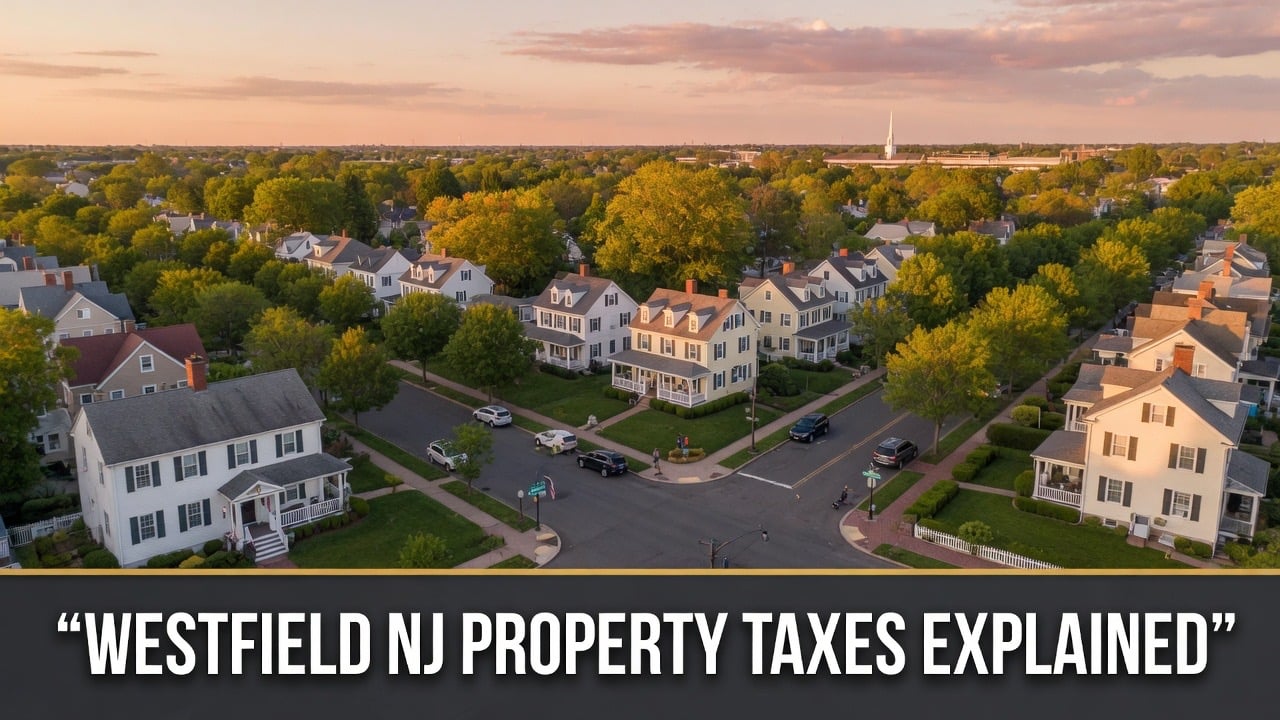
Westfield NJ · 2025 Property Tax Snapshot
The first question most buyers ask about Westfield is the tax bill. The first number they find is $18,948. And for a lot of people, that ends the conversation before it starts.
That number is real. It positions Westfield as the second-highest municipality in Union County, behind only Summit at $19,701. It exceeds the New Jersey statewide average of $10,570 by nearly $8,400. It is a genuine, significant annual financial obligation and no serious buyer should dismiss it.
But here is what the raw figure consistently obscures: Westfield’s effective tax rate — the proportional burden on the true market value of the home — is 1.810%. That rate is lower than Cranford (2.106%), lower than Scotch Plains (2.137%), and lower than Garwood (2.059%). Homeowners in those towns pay less per year in dollars and simultaneously pay a higher percentage of their home’s actual worth. The math works because Westfield’s aggregate residential and commercial property has been valued by the Union County Board of Taxation at $10.86 billion — an enormous denominator that generates massive total revenue at a proportionally moderate rate. The high cost of entry, in other words, partially insulates the effective rate. That distinction matters for anyone doing a serious equity analysis across towns.
The table below makes the paradox visible.
| Municipality | Avg Tax Bill (2025) | Effective Rate |
|---|---|---|
| Summit City | $19,701 | 1.475% |
| Westfield Town ★ | $18,948 | 1.810% |
| Scotch Plains Twp | $15,818 | 2.137% |
| Cranford Twp | $13,729 | 2.106% |
| Mountainside Boro | $13,309 | 1.566% |
| Clark Twp | $11,951 | 1.899% |
| Garwood Boro | $11,725 | 2.059% |
★ Subject municipality. Source: Union County Board of Taxation; NJ Division of Taxation. 2025 data. See footnotes.*
The number on your annual tax bill is not a single charge. It is three completely separate levies, assessed by three different governmental bodies, growing at three different rates — and almost entirely beyond the control of any local elected official you can vote out at a Westfield town council meeting.
The first and by far the largest is the local school district levy, which funds the Westfield Public School District directly. The second is the municipal purpose levy, which funds town operations: police, fire, DPW, recreation, and administration. The third is the county levy, which Union County assesses to all municipalities annually to fund regional infrastructure, parks, the county prosecutor, and the vocational-technical school system.
Statewide, New Jersey’s average property tax dollar breaks down roughly as follows: approximately 52 cents to the local school district, 30 cents to the municipality, and 18 cents to the county. In Westfield — where the state contributes almost nothing to public school funding — the school share of the bill runs even higher. That is where the weight lives, and that is where this post begins.
The Westfield Public School District’s tentative budget for the 2026–27 school year totals $146.7 million. Of that, $129.8 million is carried by local property taxpayers. State aid — the funding Trenton theoretically provides to equalize educational opportunity across New Jersey — contributes $9.4 million. That is roughly six cents on every dollar the district costs.
This is not a budgeting anomaly. It is the direct, structural consequence of New Jersey’s School Funding Reform Act, which calculates each district’s “Local Fair Share” — what the state believes local taxpayers can afford before state dollars are needed. In a municipality with Westfield’s aggregate property wealth and household income profile, that calculation concludes local taxpayers can fund nearly everything. So the state sends nearly nothing. The average school tax component of a Westfield property tax bill lands at approximately $12,464 per household for the 2026–27 budget cycle alone.
What buyers rarely hear alongside that figure is where the money lands. When benchmarked against a cohort of seven comparable Union County school districts using NJ Department of Education per-pupil expenditure data, Westfield ranks 5th out of 7 in total per-pupil spending — meaning it does not operate the most expensive district in its peer group. More strikingly, Westfield ranks last among its peers in both administrative overhead per pupil and facility maintenance expenditures per pupil. It simultaneously ranks first regionally in basic skills and remedial spending, and second in health services and employee benefits.
The structural implication is important for buyers skeptical of the bill: Westfield’s high school levy is not driven by administrative bloat. The district’s scale allows it to amortize fixed overhead across a large student population and channel the maximum yield of the local levy directly into classrooms and student services. The price is real. What it buys is also real.
The municipal portion of your Westfield tax bill covers local government operations: the police department, fire suppression, public works, recreation programs, and municipal administration. This is the component most directly influenced by decisions made at Town Hall — and the one where engaged local residents have the most leverage over long-term outcomes.
The county portion operates by a different mechanism entirely. Union County apportions its total annual budget to individual municipalities strictly based on each town’s equalized true market value — not on population, not on service consumption, and not on local fiscal hardship. Because Westfield’s aggregate property has been valued at $10.86 billion, the town absorbs a disproportionately large share of whatever Union County decides to spend in a given year. When the county expands its budget, Westfield’s absolute tax obligation increases commensurately — regardless of what the local government does. Residents are, in effect, subsidizing county-wide services on behalf of lower-wealth municipalities throughout the region.
Then there is the cost that appears on no tax bill at all.
Like most of central Union County — including Cranford, Scotch Plains, and Clark — Westfield does not provide municipal garbage collection. Residents contract individually with private haulers for standard solid waste pickup. The municipality maintains a centrally contracted recycling program (curbside collection through Interstate Waste Services), but routine trash removal is a private expense paid outside the tax system entirely. At current market rates across central Union County, that annual contract typically runs upwards of $800 depending on hauler and service level. That cost is paid in post-tax dollars and does not appear in any published tax comparison between municipalities. Buyers modeling true annual carrying cost should add it explicitly.
Before 2018, Westfield homeowners could deduct the entirety of their local property taxes — plus New Jersey state income taxes — from their federal taxable income. A household carrying a $14,000 property tax bill and $10,000 in state income taxes could shelter $24,000 from federal taxation. The premium cost of living in a high-tax, high-service community was meaningfully softened by that federal offset.
The Tax Cuts and Jobs Act of 2017 capped the State and Local Tax deduction at $10,000. It has not moved since.
Westfield’s average property tax bill is $18,948. Before accounting for a single dollar of New Jersey state income tax, the average Westfield homeowner exceeds the federal SALT cap by approximately $8,948. That entire overage is paid in fully taxed post-tax dollars — income the federal government taxes normally and then taxes again, indirectly, by declining to recognize it as a deduction. Add any NJ income tax liability and the unrecovered exposure compounds substantially further.
The comparison to neighboring towns is not linear — it is structural. A buyer in Clark Township carries an average bill of $11,951. That household modestly exceeds the SALT cap on property taxes alone, losing a relatively contained deduction. A buyer in Westfield completely obliterates the cap. The entire increment between a $12,000 bill and a $19,000 bill is paid without any federal offset whatsoever. That changes the real affordability arithmetic in ways that do not appear in a standard mortgage payment estimate — and buyers financing at the upper end of their capacity should model PITI alongside SALT exposure before committing. For a full accounting of additional purchase-side costs in New Jersey, the 2026 NJ closing costs guide details what buyers are actually paying from contract to keys.
New Jersey’s ANCHOR program — Affordable New Jersey Communities for Homeowners and Renters — is the state’s primary direct property tax relief mechanism. Eligible homeowners receive rebates in the range of $1,000 to $1,500 depending on income level and primary residence status. For qualifying households, it represents a meaningful, real cash offset against the annual tax obligation, and any eligible Westfield homeowner should apply without hesitation.
The structural limitation is straightforward: ANCHOR is means-tested and phases out above higher income thresholds. Westfield consistently ranks among the highest-income municipalities in the United States. A substantial share of the town’s homeowner population falls at or above the income ceiling for maximum benefit — or is rendered partially or entirely ineligible. For that cohort, the full $18,948 average bill lands without any state-level rebate offset. The ANCHOR program is valuable relief for New Jersey as a whole. In Westfield specifically, it does not materially change the carrying cost calculus for many of the buyers this market attracts.
Westfield’s tax bill is high. It will almost certainly continue to climb — the 2% statutory levy cap is under constant structural pressure from contractual wage obligations, healthcare costs, and a school district whose operational expenses grow faster than inflation permits. Buyers should build in annual tax increases of at least 2% in any long-range carrying cost projection.
But Westfield’s effective rate of 1.810% tells a different story than the headline number. Relative to the underlying equity being held, the proportional burden is lower than most of the surrounding region. The school district routes its levy into classrooms and student services rather than administrative overhead. The homes that carry this tax bill have historically held value with remarkable resilience — and the resale market in Westfield is among the most liquid in Union County, with buyer demand supported by the same school premium that drives the bill upward.
The buyers who get into financial trouble in Westfield are consistently those who budget only for the mortgage. The tax bill, the private hauler, the SALT exposure, and the structural reality that state school aid is effectively zero for this district — all of it needs to be modeled before the decision, not discovered after closing.
For a current read on pricing, days on market, and what inventory actually looks like in Westfield heading into mid-2026, the Westfield 2026 market report has the numbers. And if you want to talk through what you can realistically carry at a given purchase price in this market, call Anthony directly at (718) 873-7345. That conversation is free. Getting the carrying cost wrong on an $18,000-per-year tax bill is not.
Q
What is the average property tax bill in Westfield, NJ?
The average residential property tax bill in Westfield reached $18,948 in 2025, per Union County Board of Taxation data. That makes Westfield the second-highest municipality in Union County, behind Summit at $19,701, and approximately $8,400 above the statewide New Jersey average of $10,570.
Q
Why are property taxes so high in Westfield, NJ?
The dominant driver is the school district levy. Westfield is classified as a high-wealth district under New Jersey’s school funding formula, which results in the state providing minimal aid — approximately $9.4 million against a $146.7 million total budget. Local property taxpayers fund nearly the entire cost of a premier school system. Compounding the issue is a thin commercial tax base: with residential property accounting for roughly 95% of Westfield’s total ratable value, homeowners bear virtually the entire municipal burden without the commercial subsidy that benefits towns like Clark.
Q
Is Westfield’s effective property tax rate higher than its neighbors?
In absolute dollars, yes — Westfield’s average bill is substantially higher than Cranford, Clark, Scotch Plains, and Garwood. But on an effective rate basis — taxes as a percentage of the home’s actual market value — Westfield’s 1.810% is lower than Cranford (2.106%), Scotch Plains (2.137%), and Garwood (2.059%). Westfield’s high property values produce a massive aggregate tax base, which allows a proportionally lower rate to generate a high total levy. The effective rate is the correct metric for comparing the real burden on equity across different markets.
Q
How does the federal SALT cap affect homeowners in Westfield, NJ?
The $10,000 federal SALT deduction cap creates an acute financial penalty for Westfield homeowners. With an average property tax bill of $18,948, the average Westfield household exceeds the cap by nearly $9,000 on property taxes alone — before a single dollar of New Jersey state income tax is factored in. Every dollar over the $10,000 threshold is paid in fully taxed post-tax income with no federal deduction offset. Buyers should model this exposure explicitly when calculating true affordability, particularly when comparing Westfield to lower-tax alternatives where the SALT overage is smaller or nonexistent.
* Tax bill figures, general tax rates, effective tax rates, and equalization ratios sourced from the Union County Board of Taxation and the New Jersey Division of Taxation (2025 certified data). School district budget figures from the Westfield Public School District tentative 2026–27 budget. Per-pupil expenditure benchmarks from NJ Department of Education User-Friendly Budget comparative reports (2024–25 school year). National effective rate comparison data via the Tax Foundation. ANCHOR program details per NJ Division of Taxation program guidelines. Private hauler cost reflects current central Union County market pricing and is illustrative; individual contracts vary. All tax bill figures represent municipal averages and are subject to annual revision by the appropriate taxing authority.
Prodigy Real Estate is an innovative real estate company offering high-end video production, home valuation services, purchasing, and home sales. Serving New York and New Jersey.